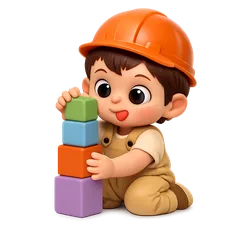
The Builder: your toddler at 23 to 25 months
Stacking, sorting and lining things up is how the world gets organized.
Between 23 and 25 months, many toddlers become builders. Stacking, sorting and lining up objects is how they test order and cause and effect. Most can build a tower of around six blocks, use fifty or more words, join two words together, and sleep 11 to 14 hours in 24 hours including one nap.
The building is not really about towers. Around the second birthday many toddlers start holding a picture in mind before they act on it, so they can plan a stack, predict a crash and try again differently. The repetition that looks obsessive from the outside is how the prediction gets tested. Knocking it down is part of the experiment, not the end of it.
The Builder at a glance
Typical ranges for 23 to 25 months. Every baby moves at their own pace.
| What | Typical range |
|---|---|
| Age range | 23 to 25 months |
| Typical sleep | 11 to 14 hours in 24 hours, naps included |
| Wake windows | around 5 to 6 hours between sleeps |
| Naps | one, usually 1 to 3 hours |
| Words spoken | often 50 or more, with two-word phrases |
| Block tower | around six blocks for many toddlers |
| Milk | about 16 ounces a day, whole milk until two |
| Active play | at least 180 minutes a day, spread across the day |
What may be happening
Body
- Many toddlers can run, kick a ball, and walk up and down stairs with a hand or a rail.
- Fine motor control is sharper, so many can stack about six blocks, turn single book pages and unscrew a lid.
- Scribbling becomes deliberate, with sweeping vertical and circular strokes rather than random marks.
- Undressing usually comes before dressing, and many toddlers can pull off shoes and manage a large zipper.
Brain
- Many toddlers now think a step ahead, running a plan in their head before their hands move.
- Sorting and matching arrive, so shape sorters, simple puzzles and grouping by color start to make sense.
- Two-word sentences become common, and vocabulary often keeps growing week by week.
- Pretend play strings actions into a sequence, like filling a cup, drinking from it and washing it up.
Connection
- Play is often side by side rather than together, and sharing is genuinely difficult at this age.
- Many toddlers copy household jobs closely, sweeping, wiping and stirring alongside you.
- Frustration when a tower falls is normal, and the same toddler may want to rebuild it immediately.
- Routines feel safer than surprises, and many toddlers object strongly when the order of things changes.
Sleep at 23 to 25 months
Most toddlers this age sleep 11 to 14 hours in 24 hours, usually 10 to 12 hours at night plus one nap of about one to three hours. Around the second birthday some toddlers start resisting the nap without actually being ready to drop it. Keeping a quiet rest period, even when no sleep happens, tends to protect the afternoon. Bedtime stalling and one more request are both very common now.
| Sleep | Typical range |
|---|---|
| Total sleep in 24 hours | 11 to 14 hours |
| Night sleep | usually 10 to 12 hours |
| Naps per day | one, usually early afternoon |
| Nap length | about 1 to 3 hours |
| Awake between sleeps | around 5 to 6 hours |
| Nap resistance | common, and rarely means the nap is finished |
Eating and mealtimes
Appetite stays smaller and less predictable than in the first year, which is normal once growth slows. Most toddlers do well with three meals and one or two snacks at roughly the same times each day. Whole milk usually continues until the second birthday and then becomes low-fat or nonfat, at around 16 to 24 ounces a day. Serving small portions and letting your toddler ask for more usually goes better than filling the plate.
- A rough guide for portions is about one tablespoon of each food per year of age, with more offered on request.
- Milk is around 16 ounces a day, whole until two and low-fat or nonfat after, and juice is best limited to about 4 ounces.
- Self-feeding with a spoon and an open cup is worth the mess, since it builds the same hand control as stacking.
- Choking risks at this age still include whole grapes, nuts, popcorn and uncut hot dogs.
Questions parents ask
How many blocks should a 2 year old be able to stack?
Why does my toddler line everything up in a row?
Is my 2 year old talking enough?
How much sleep does a 2 year old need?
Why does my toddler get so angry when their tower falls?
More questions about 23 to 25 months
The things parents actually search for at this stage. Tap any question to open it.
Is it normal that my toddler only wants to knock towers down, not build them?
Should I worry if my toddler lines up toys instead of playing with them?
Why does my toddler want the same book read over and over?
How do I stop my toddler throwing toys?
Is it normal that my 2 year old is not interested in other children?
When should a toddler use a spoon properly?
Why does my toddler melt down if I put their cup in the wrong place?
How much screen time is ok at 2 years old?
Is it normal that my toddler is still not sleeping through the night at 2?
Should my 2 year old be in a bed instead of a crib?
Why has my toddler suddenly started eating almost nothing?
How many words should a 2 year old say before I ask for help?
Is it normal that my toddler prefers one hand already?
Why does my toddler climb on everything?
Can I still give my 2 year old a bottle?
When to check in with your doctor
Willo is a parenting companion, not a medical app. If something feels off, ask.
- Speak to your pediatrician or health visitor if your toddler is not putting two words together by around two, has very few words, or has lost words or skills.
- Ask for advice if your toddler is not walking steadily, is not running by around two, or seems to consistently avoid using one hand or one side of the body.
- Mention it if your toddler does not respond to their name, rarely makes eye contact, or does not share attention by pointing things out to you.
- Contact a doctor about losing weight, refusing all fluids, or gagging and coughing frequently at meals.
Walk The Builder with someone who gets it
This page is the map. Willo is the daily companion: what to expect today, gentle nudges for this exact phase, and somewhere to put how you are feeling.
Download WilloFree tools for this age
No sign up, no email. They run in your browser.
Sources
- American Academy of Pediatrics. Hand and Finger Skills: 2 Year Olds
- American Academy of Pediatrics. Cognitive Development: 2 Year Olds
- American Academy of Sleep Medicine. Child Sleep Duration Health Advisory
- NHS. Physical activity guidelines for children under 5 years
Last reviewed 2026-08-24. Ranges are typical, not targets.

